Many of us know that China has a One Child Policy, but what exactly are the effects does it have on the Chinese public? Let's find out.
1) First, most of the children in China misuse the term 'brother' and 'sister'. Being an only child and with friends being the same, these children are unable to grasp the real meaning of a generic 'sibling'. Most of the children, if you ask them if they have any siblings. They will respond 'Yes I do, many siblings.' But if you ask them who are they, the children will reply 'My aunt's/uncle's children."
2)The children won't experience caring and sharing for someone, that is, their sibling. Showered with undivided love from their parents, the children won't be able to experience what is like when attention from them is being snatched away when the younger sibling is born.
3) The generation of children now are more educated than the previous few generations. Now that the family have only one child's education to invest in, many families are capable of paying for the children's education and extra things to help with the children's learning such as revision books and tuition.
4) the children feel compelled to stay with their parents. Although many of them have big dreams and wishes to travel to other countries to work, they felt that if they leave their parents, no one will be taking care of them and thus, they choose to stay with them, limiting their career experiences.
So is the One Policy a good thing or a bad thing? I can't say whether is it good or bad, but I'm just happy that Singapore does not have this policy.
Friday, 11 April 2014

Thursday, 3 April 2014
What is hot or cool to the youths in China/Singapore?

Hot
1) weibo
2) QQ (my parents have it... And I guess ALL the people, no only the youths, has it)
3) Happy Farm 快乐农场 (this is the game most youths play... My cousin also has it)
4) Wearing pyjamus on street trend (there was a newspaper report about it, saying that many Chinese wore pyjamus as it is comfortable)
5) 泪奔 -- that small little cat crying image-- using to do this expression 😭
Cold
1) youtube (the Chinese is banned from using it... So sad...)
2) Facebook( I don't usually see them using)

Hot
1) Anime!! (A lot of Singaporeans youths LOVES animes... There are a handful in our class too... There are some like 'Koroko No Basket' or what, talking about basketball. My favourite is 'Detective Conan'!!)
2) K-pop (such as Bing Bang, Exo, Girls' Generation... My friend listens to these songs EVERYDAY)
3) Running Man! (Likes Ji-Hyo --sorry if I spelt wrongly)
4)Singapore 'unique' third-language, Singlish
British way: Excuse me, could you please make way.
Singaporean way: Siam lah!!
5) Hawker centre
6) social medias like Facebook, youtube, Instagram, Twitter....
Cold
1) Real propre British English (practically no one speaks that, unless his/ her family have some relations with the continent, Europe)
2) traditional jobs (many of them are vanishing in Singapore. Many youths don't do these'old' jobs like cobbler and streets barber since we have a high-tech way.)
Thursday, 13 March 2014
Andrew Bae Jong Seong - Great Wall of China
The Great Wall of China is a series of fortifications made of stone, brick, tamped earth, wood, and other materials, generally built along an east-to-west line across the historical northern borders of China in part to protect the Chinese Empire or its prototypical states against intrusions by various nomadic groups or military incursions by various warlike peoples or forces.Furthermore, the defensive characteristics of the Great Wall were enhanced by the construction of watch towers, troop barracks, garrison stations, signaling capabilities through the means of smoke or fire, and the fact that the path of the Great Wall also served as a transportation corridor. Although it caused many deaths, the Great Wall of China was still strongly built and it is also served as a historical structure in China. I still cannot believe that it is built by human beings, I learned that no matter how hard the task is, if we can unite as one, motivate each other, the task could be done.

EVELYN ANG (2) 2J 兵马俑
The Terracotta Army or the "Terracotta Warriors and Horses", is a collection of terracotta sculptures of the armies of Qin Shi Huang, the first Emperor of China. It is a form of funerary art buried with the emperor in 210–209 BC. It is believed to protect the emperor in his afterlife.


(Erm.. Not really handsome...)
The figures, dating from around the late third century BC, were discovered in 1974 by local farmers in Lintong District, Xi'an, Shaanxi province. The figures vary in height according to their roles, with the tallest being the generals. The figures include warriors, chariots and horses. Current estimates are that in the three pits containing the Terracotta Army there were over 8,000 soldiers, 130 chariots with 520 horses and 150 cavalry horses, the majority of which are still buried in the pits near by Qin Shi Huang's mausoleum. I felt that it is quite honorable, since a king has so many people to 'protect' him even in the afterlife, and quite amazed by the olden Chinese's way of thinking... Hmm. Quite unique...
(It feels so majestic! OMG!)
BIRD'S NEST STADIUM GRACE DENG ZHEYUN (7) GROUP 5 2J
The Bird's Nest (鸟巢), officially known as Beijing National Stadium (国家体育场), was the crown jewel of the Olympic Green (in case you don't know, the Olympic Green is an Olympic Park in Chaoyang District, Beijing, China constructed for the 2008 Summer Olympics). The stadium was designed for use throughout the 2008 Summer Olympics and Paralympics.


Overview of Bird's Nest Stadium (Ah.. Nice..)
I first saw it through a book, introducing all the great architectures of the world. Beijing National Stadium is one of them. Like its name, the Bird's Nest looks like the home of a big, enormous bird. As I was interested in it, I searched online for more interesting details about it. The stadium has a volume of three million cubic metres (omg!!) and is considered to be the world's largest enclosed space! It also features monstrous (I totally agree) steel elements weighing up to 350 tons a piece intertwined in such a fashion that this gargantuan structure actually looks quite delicate. I googled the pictures of it, and guess what? As I saw the interior of the stadium, I was shocked. Who can design such a complicated and unconventional building? They are Ai Weiwei, Jacques Herzog,Li Xinggang and Pierre de Meuron. Ok, but my main point isn't about the architects, it's about the design. The interior looks magnificent, like we are some wriggly worms in the huge nest. There are poles which looks like twigs of nests hanging from the building!

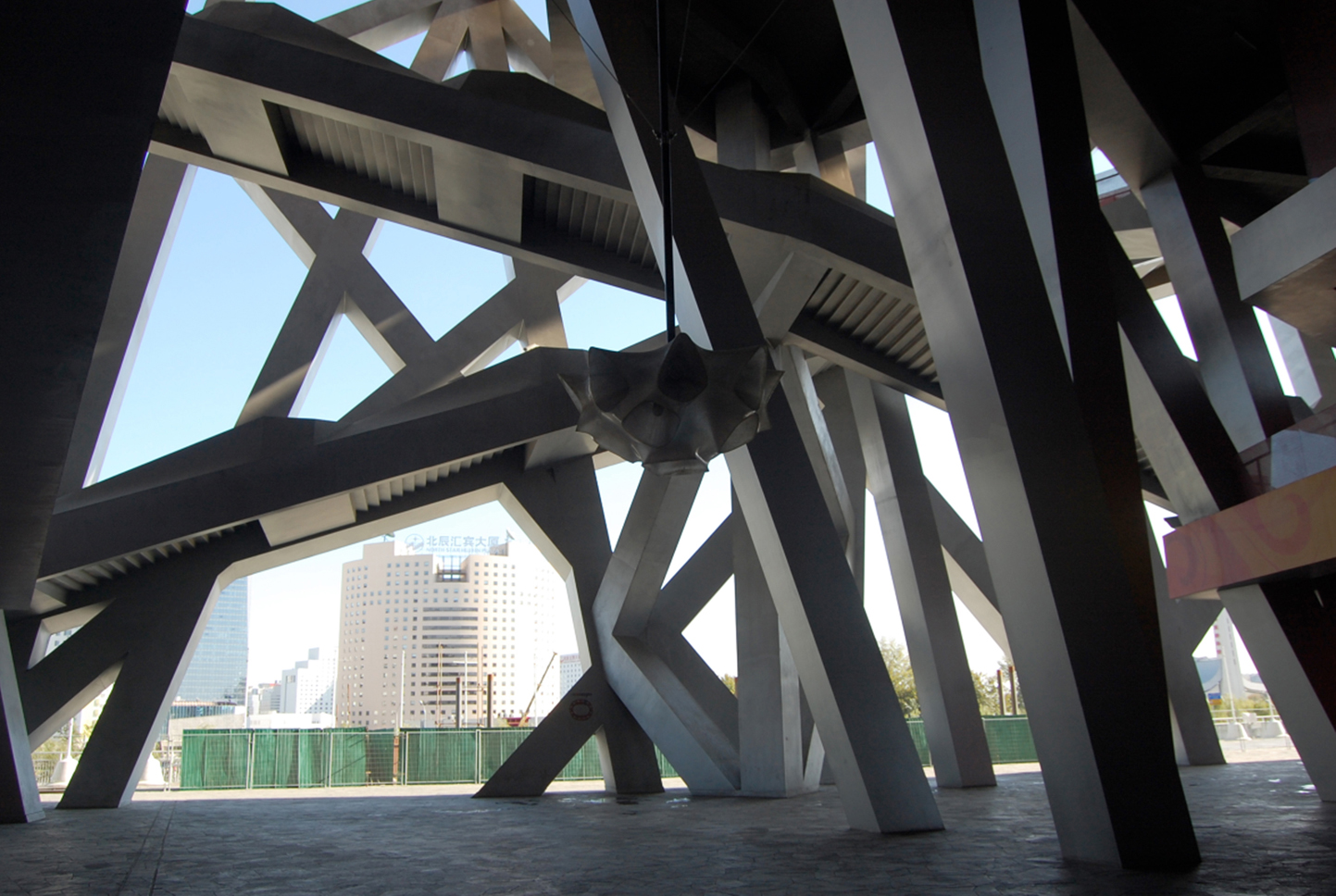
Complicated, artistic, huh?
However, it's also quite risky. Imagine, over 70% of the building's weight hangs over the audience's head. What if it is not strong enough... And sways and sways... And finally... Finally... drops? Er... Let's stop thinking in that direction... Although there is a risk, I still choose to believe that the poles will not drop to the ground. Although seemingly random, the pattern abides by complex rules imposed on the structure in order to be able to define the geometry. So, let's put 100 hearts--放一百个心好了,不会有事的!
'Fraid not!
As what the Chinese believes, the circular shape of the stadium represents heaven and the circular form of the National Stadium represents Heaven, while the adjacent square form of the National Aquatics Centre (北京國家游泳中心) or Water Cube, is a reflection of the Chinese symbol for Earth. With the heaven and the Earth, this is the world!
One heaven and one Earth, 绝配!
Just like the Great War of China, Beijing National stadium is a magnificent building. It's a pity to not have been listed in the Seven wonders of the world... :~( Everyone will definitely remember it! From this research and this design, I've learnt a lot. We have to think out of the box (creatively) when inventing or designing things, so that your's will be a uniquely new design.
LEONARD SIM (30) GREAT WALL OF CHINA
Leonard Sim (30) 2J
The Great Wall of China was built from the 3rd century BC to 17th century AD.The Great Wall reflects collision and exchanges between agricultural civilizations and nomadic civilizations in ancient China. It provides evidence of the far-sighted political strategic thinking and mighty military and national defence forces of ancient China, and is an outstanding example of the superb military technology and art of ancient China at that point in time. It's significance as the national symbol for ensuring the security of the country and its people is widely known in China.

The Great Wall of China was built from the 3rd century BC to 17th century AD.The Great Wall reflects collision and exchanges between agricultural civilizations and nomadic civilizations in ancient China. It provides evidence of the far-sighted political strategic thinking and mighty military and national defence forces of ancient China, and is an outstanding example of the superb military technology and art of ancient China at that point in time. It's significance as the national symbol for ensuring the security of the country and its people is widely known in China.
Thursday, 13 February 2014
Reflection (Week 3)

P.s. We all chose week three as that's the only time we had group work and not only some normal lesson, and we all paid 100 percent attention to the teacher!
TAN WEN CONG
During CID, we were asked to describe our school environment in 4 words. I thought for some time and finally decided on the word: dull. I just felt that most of the people were too cliquish and never bothered include everyone in one activity. They were all only willing to stay in their own cliques, not wanting to step out and include more friends in their activities. Many will think that my view is wrong and negative, but this is simply my subjective perception of the school environment. This perception of mine can easily be changed if only they had been more inclusive of everyone. If only. During the lesson, I learnt that when writing blog, we cannot wrote it like a boring narrative story, but add more feelings.
EVELYN ANG XIN RUI
During CID, our teacher gave us a huge piece of majong paper and post it notes for us to discuss on the environment of RV. Personally, I think that RV has a nice and quiet environment and could not understand why some of my group mates said that it was "boring". (WHY??)After listing out a few words, we classified them into two categories, "Negative" and "Positive". After discussing further, we were asked to present to the class. During the lesson, I learnt that when writing blog, we cannot wrote it like a boring narrative story, but an interesting journal, or else the reader will end up giving up reading it.
ANDREW BAE JONG SEONG
During the CID lesson, we discussed as a group about the environment in RV. We came up with two negative and two positive words that best describes the environment in RV. They are cheerful, calm, dull and stressful respectively.
During the lesson, I have learnt that when looking at photographs, we need to have some analyzing skills. Not only it has to depicts facts, but also emotions inside.
My friend, Leonard was foolishly playing with his basketball in class. Our teacher did not really care about him until when our classmate was presenting his words, he accidentally dropped it on the floor. The ball bounces off the floor and our teacher quickly confiscated it. Leonard was very stupid and I could not stop my laughter for a while.
LEONARD SIM BAO HUA
CID was fun. We discussed about the environment of RV. I could only think of very negative words of RV, such as boring, noisy, full 'hatred', tired... However, my group mates didn't wrote all of those down. They are 'goodie goodie' people. Finally, they wrote cheerful, calm, dull and stressful, grouped under positive and negative. I thought that it should be grouped under lies and truth, shouldn't it? During the lesson, I have learnt that when looking at photographs, we need to have some analyzing skills. Not only it has to depicts facts, but also emotions inside.
GRACE DENG ZHEYUN
During the CID lesson, we all discussed about the environment of RV and wrote ouranswer on . To be frank,I don't know how to answer this question. It's too suddenfor me... Interesting? Nah, it's quite dull and boring. Stress-free? Nah (again), it's very very extremely stress-FFFUUUUUULLLLLLLLLLL!! Leonard 'helpfully' suggested noisy, tiring, etc. I wanted to say,"Thank you ah, Leonard, but can you give positive stuffs?" Finally, we decided on cheerful, calm, dull and stressful, grouped under positive and negative. Leonard wanted to group these under truth and lies, he felt that negative was how he truly felt about RV.
During the lesson, I have learnt that when taking photographs, we need to frame the objects in our photo. for example, we will place our subjects at the intersection of the thirds and we will create an interesting composition.

“PHOTOGRAPHY IS NOTHING”
This is a quote by Henry Cartier-Bresson we learnt. I thought this might spark some thought. Sometimes, we became so bogged down in 'looking for pictures' that we forget about being in the moment and enjoying life.
Subscribe to:
Posts (Atom)